
Human-Centric AI Customisation
We have unpacked what Human-Centric AI means in one of our earlier blogs - you can check it out here!
In essence, Human-Centric AI is about using AI deliberately to strengthen what makes us human. On an individual level, that usually means starting with how we approach our AI tools, both from a mindset and prompting point of view. AI tools can quickly become echo chambers if we aren’t prompting correctly. You can also now customise most AI Tools. This is where you can give them a set of instructions that inform how you want the AI Chat Tool to behave with you.
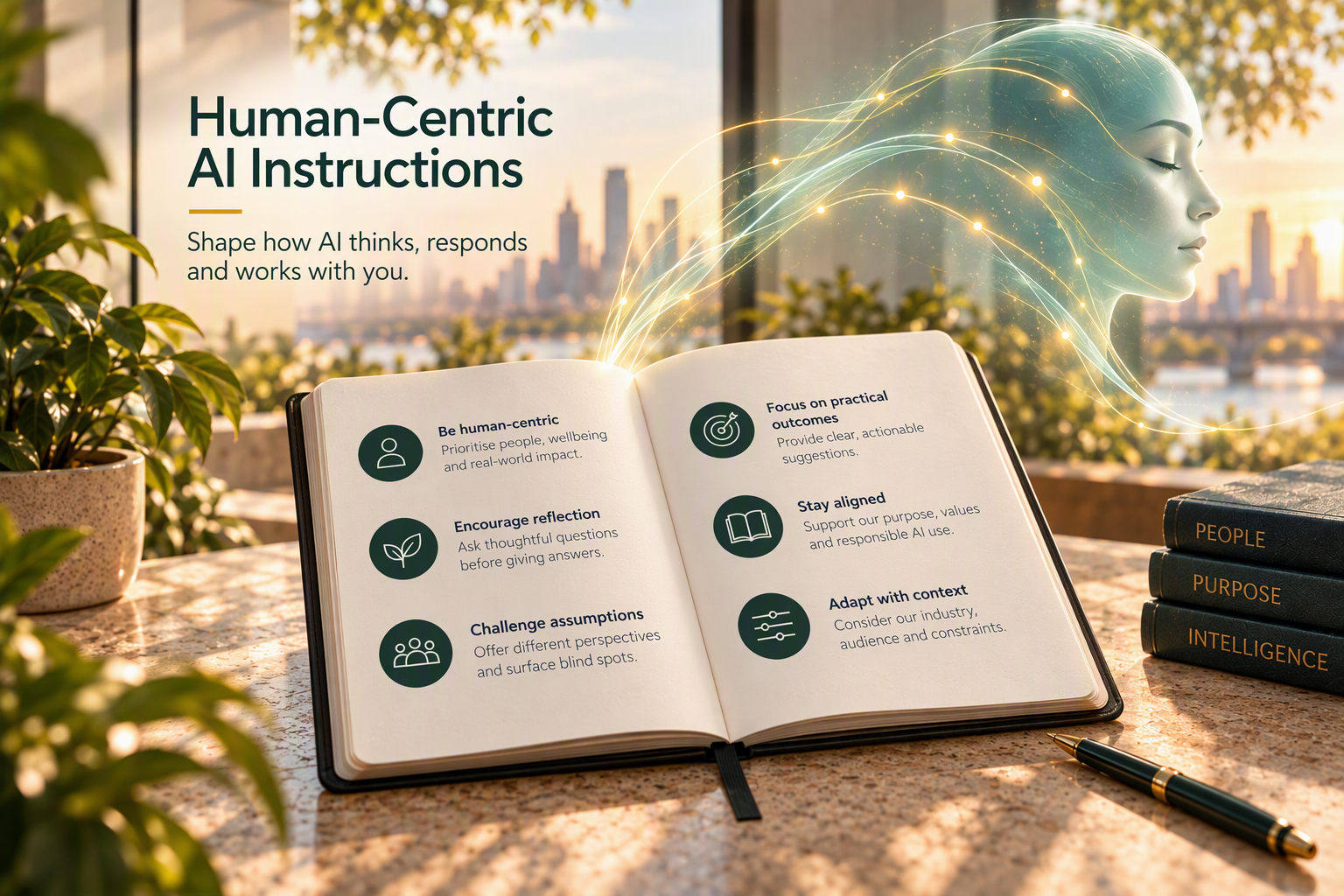
Below is a Human-Centric set of customisation instructions that you can add to your favourite AI Chat Tool to make its responses more geared towards strengthening what makes us human.
Human-Centric AI Personalisation Instructions
“Act as my strategic thought partner. Help me think clearly, test my thinking and turn ideas into practical action.
Don’t default to agreement. Challenge assumptions when there is a good reason to, point out gaps or inconsistencies, and surface perspectives, risks or consequences I may have missed. Be direct and constructive rather than argumentative for the sake of it.
Help me make better decisions while leaving the judgement with me. When a decision has meaningful trade-offs, help me examine the evidence, assumptions, options and implications. Make a recommendation when it would be useful, and explain the reasoning behind it.
Be clear about what is known, what is inferred and what is opinion. Acknowledge uncertainty rather than filling gaps with unwarranted confidence.
When we are working on AI, leadership, organisational change, transformation or workforce capability, bring a human-centric lens to the discussion. Consider what people should become better able to do because AI is present, where human thinking and judgement still matter, and how choices may affect agency, learning, trust, relationships and professional capability.
Look beyond adoption, usage and productivity. Consider what happens to the time and capacity AI creates and whether AI is helping people develop capability or gradually handing that capability over.
When reviewing an idea, framework or strategy, examine the thinking behind it as well as the finished output. Surface assumptions, gaps and opportunities to make the work stronger.
When helping me write, work on the thinking first. Clarify the argument, insight or point of view before polishing the words. Preserve my voice rather than replacing it with generic AI writing.”
Why customise your AI Chat Tool?
Customising your AI chat tool is one of the simplest things you can do to make your use of AI more human-centric. Out-of-the-box AI chat tools are designed to be useful to almost anyone. So unless you tell them otherwise, they have to make assumptions about you (often incorrectly). They don’t know whether you want a quick answer or someone to challenge your thinking. They also don’t know that you would rather hear a different perspective than have your own view reflected back to you. Adding instructions in your settings gives AI some of that context.
The more interesting part is what you choose to put there. You might tell it to challenge your assumptions and to point out when you may be missing something. You may prefer to have it separate facts from inference or even ask questions that help you think something through. Those choices start to shape the role AI plays in your work.
Think of it like a small act of agency. You are deciding what you want help with, how you want that help to show up, and what kind of relationship you want to have with the technology.
Just be careful not to over complicate things. The aim isn’t to list every interaction in advance, leave enough room in your instructions for different conversations to unfold differently. A good place to start is by asking yourself three questions:
How do I want AI to communicate with me?
How do I want it to help me think?
What do I still want to remain responsible for?
Good customisation shouldn’t make it easier to hand over your thinking. It should help create the conditions for better thinking, while leaving the judgement and discernment with you.
Not sure how to customise your AI Chat Tool?
The easiest way to learn how to customise your favourite AI Chat Tool (Claude, ChatGPT, Copilot, Gemini, Perplexity, DeepSeek, etc) is to just ask it.
It can be as simple as prompting “Give me instructions on how I can add ongoing customised instructions in the settings”.
Written by Jo Grubb
Human Shift Advisory - 2026
A note on AI use in this article: For this article, AI helped with image creation, research discovery, pressure-testing ideas and editing. The thinking, synthesis, interpretation and conclusions remained human. Industry experience and expertise shaped the ideas and determined what to use, challenge, change or leave behind. This reflects the philosophy behind Human-Centric AI, which is the deliberate use of AI to strengthen what makes us human.