
Human-Centric AI unpacked
What is Human-Centric AI?
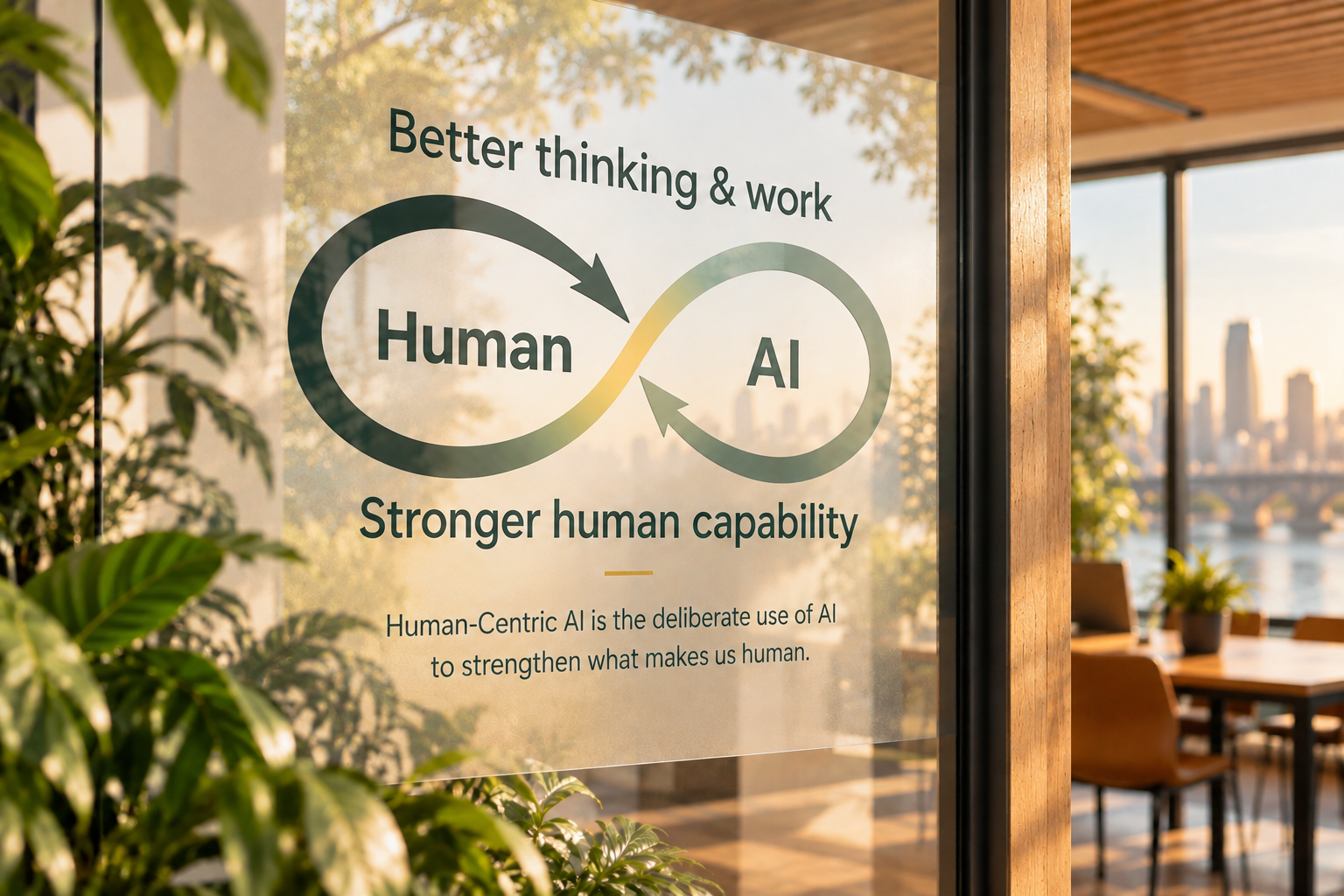
Human-Centric AI is the deliberate use of AI to strengthen what makes us human.
As AI becomes part of how we think, decide and work, the question is not simply "what the technology can do?". It is also "what we are strengthening through its use?". Human-Centric AI asks us to be deliberate about what we hand to AI, what we retain, and what we want to develop through the relationship we build with it.
Those choices show up everywhere. In how individuals use AI to think, learn and make decisions. In how organisations decide where human value matters most. And in how leaders help people adapt to a technology that is changing not only the work itself, but also how we change.
Consider two leaders preparing for a difficult performance conversation. One asks AI to draft the feedback. The other arrives with a point of view, then uses AI to explore what the person needs to hear, where their own blind spots might be and how the conversation could land. Both use the same tool. One delegates much of the thinking. The other uses AI to prepare more thoughtfully for a human interaction.
Researchers describe the distinction as beneficial and detrimental offloading. AI may remove effort that adds little value, leaving more attention for work that does. It may also remove the experience through which someone further develops their critical thinking or people skills. On a productivity and adoption dashboard, both situations can look remarkably similar, the outcomes however could not be further apart.
The same choice appears at an organisational level. When AI gives time back, an organisation can absorb that capacity into higher expectations. It can also ask what people should now have more space to think about, improve or do differently. From a product and/or service lens, it asks, "where does the real human-value sit and how can we leverage AI to protect and enhance that?".
Human-Centric AI shapes the choices an organisation makes, the way people use AI in their daily work, and how the change is led over time.
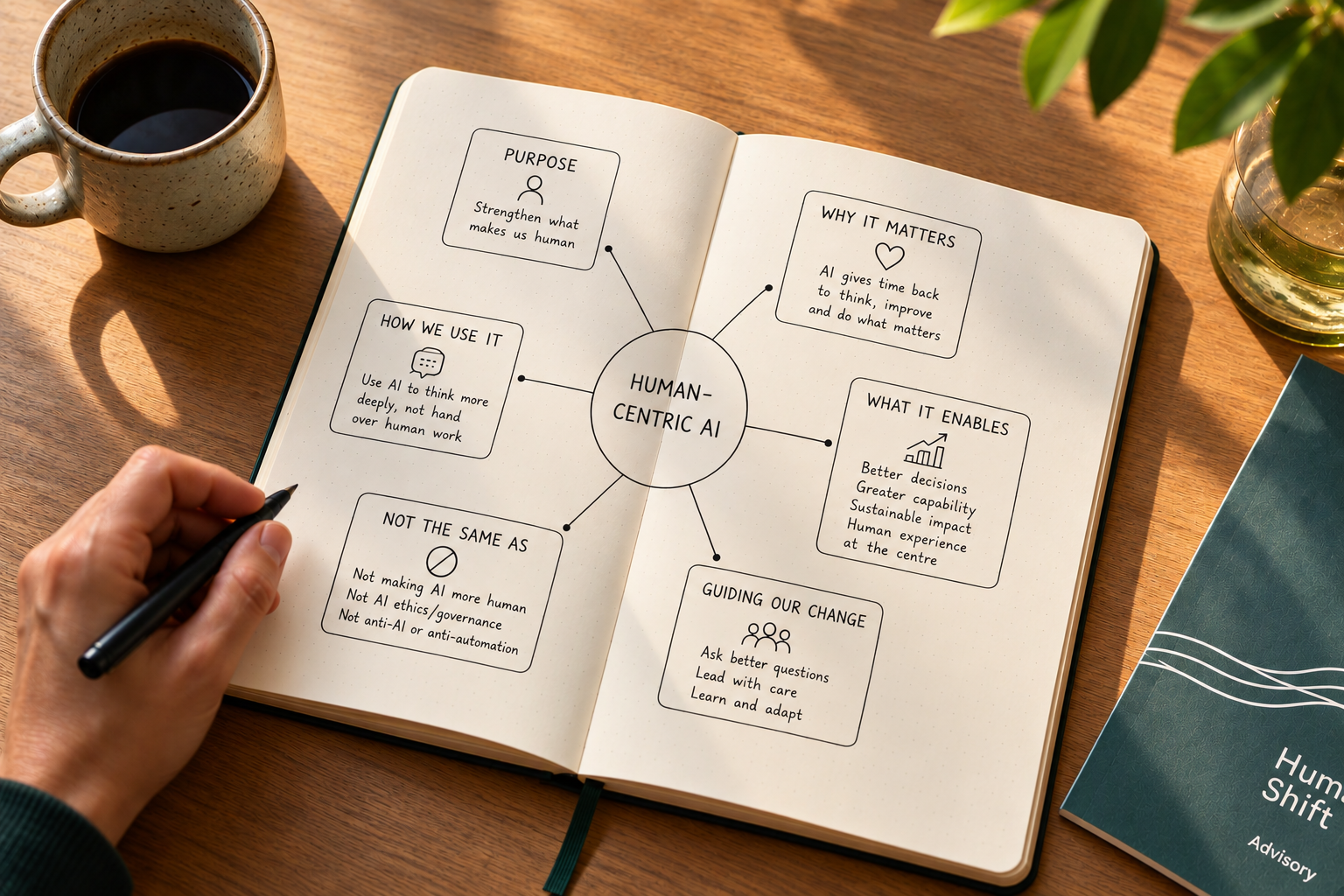
Human-Centric AI
The deliberate use of AI to strengthen what makes us human.
Human-Centric AI in the individual
Two employees can use the same AI tool twenty times in a week and have completely different experiences. One uses it to challenge assumptions, explore alternatives and improve work they remain capable of judging. Another delegates most of the thinking and accepts whatever comes back. The usage data looks identical. The human outcomes are anything but.
A human-centric approach therefore pays attention to engagement quality, not only frequency of use. AI can help people learn faster, widen their thinking and make better decisions. It also makes it surprisingly easy to hand over the practice through which judgement, confidence and expertise develop.
Agency is a useful way to understand the difference. Are we still the author of our own thinking, or are we gradually becoming the reviewer of an answer formed for us? To test this, a good question to ask is:
"If AI disappeared tomorrow, would the people using it be more capable than before they started?"
So what might that look in practice? One practical response is to approach AI with a thinking method rather than simply asking for an answer. Edward de Bono's 6 Thinking Hats can help us do this. It asks us to examine a decision through six perspectives: facts, feelings, risks, benefits, possibilities and the process for bringing the thinking together. Used well, it helps us explore a situation more thoroughly. It can challenge assumptions, surface alternative perspectives and uncover themes that may otherwise be missed.
Human-Centric AI introduces a seventh hat that takes a different perspective again. It helps unpack the effect the interaction with AI is having on the person using it and brings judgement, agency, learning and long-term capability into the conversation. It encourages people to think about what they are strengthening through the interaction, not just what answer they receive.
The goal is thoughtful use of AI that leaves us more capable than it found us.

Want to take this further?
Combining Edward de Bono's six perspectives with a Human-Centric AI hat offers a practical way to work through a real decision. It’s a simple as using the right prompt in your favourite AI tool.
Explore the 7 Hat Thinking approach and start using the prompt today. Click here
Human-Centric AI in the organisation
A human-centric perspective changes the AI conversation at the organisational level too. Efficiency is an understandable and very common starting point. The outcome, however, can look very different depending on what the organisation is trying to strengthen.
Consider two AI productivity use cases…
The first - A real estate agency automated much of the administration involved in managing rental properties, including inspection scheduling and routine coordination. They adopted AI, but the real interesting decision came afterwards. The agency took time to understand where the real human-value sat in their business and used some of the capacity AI freed up to put more people on the phones. They knew that responsiveness and human contact mattered to tenants and owners and chose to use AI enhance this. The outcome? They were able to use this differentiator to enhance responsiveness and expand their commercial footprint as a result.
Now let's look at the second - A house washing business also adopted AI and brought it in to pick up a lot of the administration. They chose to create an AI voice agent to handle initial enquiries for quotes. AI saved them time in the same way it had for the real estate agency, however the outcome was starkly different. Customers often wanted to speak to a human to explain their situation, feel understood and decide whether they trusted the business with their home. The conversation selected for AI automation was also the conversation where trust was being formed. Some interactions create trust. Once those interactions are automated, the efficiency gain can come at the expense of the value customers were actually looking for.

Both organisations used AI to improve efficiency. Their choices about where the real human value sat in their business were different, and the outcomes had not just a material effect on their customer experience, it also impacted their bottom line. Understanding where people create value helps an organisation decide where AI belongs. That value may come from judgement, empathy, creativity, trust, accountability, relationship-building or simply the reassurance of speaking with another person at the right moment. Making this a priority is an example of taking a Human-Centric approach to AI.
This doesn’t mean preserving human involvement everywhere.
Sometimes automation will be the most human-centric choice. Few customers need a heartfelt conversation about scheduling a routine inspection. Human involvement can add delay and frustration when it contributes little to the outcome. The decision depends on what people value in that particular moment.
The Human-Centric AI concept affects more than technology choices. It shapes roles, capability development, customer experience and measures of success. If AI saves thousands of hours, what happens to that capacity? It might be absorbed into more work. Or it might create better customer conversations, stronger decisions, improved services and products, or even just more time to innovate and engage the workforce.
Human-Centric AI therefore asks organisations to think beyond what AI can do and become much clearer about what they want people to become better able to do because AI is there.
Want to take this further?
A useful place to begin with AI is to map where human value really sits across a process, product or service. Where would AI improve the experience, and what human elements need to be preserved?
Explore the Human Value Mapping approach today. Click here
Human-Centric AI as a change and adoption strategy
Artificial intelligence can now take on parts of the thinking that have traditionally sat with people. That changes the AI adoption and change management conversation considerably.
Traditional change frameworks answer two questions well: can people use it, and will they work this way? A third question now sits alongside them… “how well are people engaging with it, and what is that doing to their capability and judgement over time?”
As the Change Management Institute’s Futures of Change research calls out: the foundations of change still matter, however the way they show up is evolving as change becomes faster, more continuous and more technologically intertwined. What does this really mean? It means it's time to upgrade the change and adoption playbook.
Human-Centric AI is about using AI in ways that strengthen what makes us human. In a change and adoption context, that means looking beyond whether people can use AI or how often they use it. We also need to understand how they are engaging with it, what is changing in the work, and what that is doing to human agency, capability, and discernment over time.
So what does this look like in practice?
It starts with being clear about the human outcome as well as the technology and business outcome. That lens changes many of the change levers available in traditional Cloud adoption playbooks.
It changes how we think about assessing change impact. Alongside changes to roles, processes, systems and skills, we need to understand where judgement sits, which parts of the thinking are being delegated, what people need to remain capable of doing for themselves, and what we want them to become better at because AI is now doing something else. Impact assessment becomes less about documenting a fixed future state and more about continuing to sense how the relationship between people, AI and work is evolving.
It changes how we think about leadership and sponsorship too. Human-centric sponsorship is not simply leaders encouraging people to use AI more. Leaders need enough first-hand experience to model thoughtful use, talk openly about where AI helps and where it doesn’t, and create the conditions for people to question it. Also keep in mind that someone saying “AI probably isn’t right for this” may not be a sign of change resistance. They may instead be exercising exactly the kind of judgement we want the change to develop.
The same applies to training and enablement. Tool proficiency matters, but it is only part of AI capability. People also need to learn when to trust AI, when to challenge it, what requires their own expertise and when AI may not belong in the work at all. The aim is not simply to create more capable AI users. It is to develop people who can work with AI without gradually handing over capabilities they still need themselves.
Communications take on a similar human dimension. AI makes it remarkably easy to create more content, more quickly and in more versions. That doesn’t necessarily make communication better. Particularly where messages are personal, sensitive or consequential, people still need to recognise the human thinking and accountability behind them. AI can help us communicate. It shouldn’t make the humans communicating disappear.
And then there is measurement. A Human-Centric AI strategy does not equate adoption with success. If success is defined as active usage, we will naturally design interventions that encourage more use. If success is a business outcome, supported by stronger human capability, the AI-value conversation expands well beyond activity and productivity.
The challenge has moved beyond helping people use AI. It now includes helping them develop thoughtful and sustainable ways of working with it.

Want to take this further?
Read The Cloud Playbook Isn't Enough for AI Adoption and explore why it needs upgrading for the AI era. Click here
Apply The Field Guide for Change Practitioners for practical ways to put Human-Centric AI thinking into practice across 12 change levers, including a new lever focused on cognitive impact. Click here
Six Human-Centric questions worth taking into your next AI leadership discussion
We have an opportunity to rethink not only processes and tools, but how AI can amplify what makes us human at both an individual and organisational level, and how it can help drive that change.
-
AI can remove effort very quickly. The harder question is what happens to the thinking that used to sit underneath that work. Before automating a task, look at whether it was also helping people build judgement, confidence or expertise. If it was, decide how that learning will happen somewhere else.
-
People will not always say out loud what AI is making them question about their role, their value or their future. If those concerns have nowhere to go, they tend to show up as hesitation, workarounds, surface-level adoption or resistance that looks irrational. Create enough space for the harder conversation before drawing conclusions about what the resistance means.
-
Leaders will find it hard to guide others through AI adoption if their own experience of the technology is still theoretical. What matters is not polished expertise. It is whether they are using AI enough to understand where it helps, where it gets things wrong and when they choose not to follow it. Sharing that learning can do more for trust than another endorsement of the program.
-
The same AI tool can strengthen someone's thinking or replace parts of it. The difference often comes down to how it is being used. Look at where people are still framing the problem, questioning the answer and applying their own judgement, and where that work is starting to move to AI by default.
-
High usage tells you people are using the technology. It does not tell you whether the work is better, whether people trust it, or whether the benefit is showing up where you expected. Follow the change into the work itself: what improved, for whom, what new effort appeared elsewhere, and whether the value lasted.
-
AI adoption does not arrive neatly and then settle. The tools, use cases and expectations keep moving. That makes time to reflect and adjust part of the change, not a luxury around it. Look for places where people can compare what they are learning, question poor use and reset how they are working before habits become embedded.
Final Reflection
The conversation about AI often begins with what the technology can do. Human-Centric AI starts with what people should become better able to do because it is there. That shift in attention changes the choices made at every level. It changes how someone prompts, what an organisation automates and what a change leader measures.
Used deliberately, AI can help us become more capable, more thoughtful and more human. The question is how we choose to work with it.
Written by Jo Grubb
Human Shift Advisory - 2026
A note on AI use in this article: For this article, AI helped with image creation, research discovery, pressure-testing ideas and editing. The thinking, synthesis, interpretation and conclusions remained human. Industry experience and expertise shaped the ideas and determined what to use, challenge, change or leave behind. This reflects the philosophy behind Human-Centric AI, which is the deliberate use of AI to strengthen what makes us human.