
Finding the Human Value-Point
What is a Human Value-Point?
It’s finding where human contribution matters as AI changes the world.
Imagine a customer calling about an unexpected charge.
An AI agent helps an employee find the account details and explain what happened. The answer is accurate, but the customer still sounds uneasy. The employee asks another question and discovers that their concern is whether the charge will happen again next month. The customer query was officially answered, but it was that extra conversation that uncovered what the employee really needed to know to resolve the customer’s concerns.
When organisations consider AI for customer service, both parts of this interaction can sit inside a task labelled “handle an enquiry”. Yet they contribute different things. Finding the information helps resolve the issue quickly. Understanding the concern helps the customer feel confident about what happens next.
This applies to more than just customer service. Moments like these are in all functions of an organisation. They are called Human Value-Point’s, which is in essence a place in the workflow where human contribution creates value that matters to someone. It is often at these points where the real value of a business sits and replacing those points with AI requires careful consideration. Get it right and the Return on Investment (ROI) conversation with AI expands, get it wrong and the bottom line gets impacted.
Human-Centric AI is the deliberate use of AI to strengthen what makes us human. Identifying and protecting, or even enhancing, the Human Value-Point’s in a business / service / product / workflow is an essential human-centric practice when introducing AI into an organisation.

Where does human involvement matter?
Look inside the task to understand what a person’s contribution adds, who values it and how AI could help strengthen it.
Looking inside the task
Human Value-Points can be easy to miss when decisions about AI are productivity focused and begin with a list of activities to automate.
In the customer enquiry, AI could retrieve information, explain a routine charge or resolve a straightforward question without anyone waiting on the phone. This is definitely a productivity gain and, for some customers, that would be a better experience. Others however may have unusual circumstances, struggle to explain their concern or need someone with the authority to make an exception. The value of where to retain human involvement becomes clearer when the organisation takes the time to understand what happens in those situations before bringing AI into the mix.
This is not new to AI. We’ve seen this play out already over the last few decades. For example, an employee just blindly following a script can leave a customer feeling frustrated and unseen (many telco’s have learnt this the hard way in the past). A well-designed automated response can provide a lot of productivity and scale benefits for an organisation, but if it de-values the experience for the customer, they will often take their business elsewhere.
Looking at what someone’s involvement adds, who values it and working out how AI can enhance this evolves the productivity conversation and sets an organisation up for longer term success in an AI era.

How will people develop judgement?
As AI changes the work, make room for the practice, feedback and shared learning that help people become more capable.
Some value develops through the work itself
There is different part of that customer conversation also worth considering.
In the case of the customer enquiry, an experienced employee recognised the hesitation because they had heard it before. They had already learned when to ask another question, when an explanation is enough and when to seek help. A newer employee still needs opportunities to develop that judgement and discernment.
If we design AI to handle more of the routine enquiries, people may be able to spend more of their time on difficult cases. That could make their work more rewarding and it could also build capability as it would see them facing more of the situations they would have historically had fewer opportunities to learn how to handle.
As AI comes in, an organisation needs to consider where human practice, feedback and support needs enhancing. Time saved through automation could help people take on more with less, or it could create room for colleagues to review difficult conversations together and learn from them. Making that decision with intent is reflective of taking a human-centric approach to finding and enhancing human value-points.
Finding the Human Value-Point
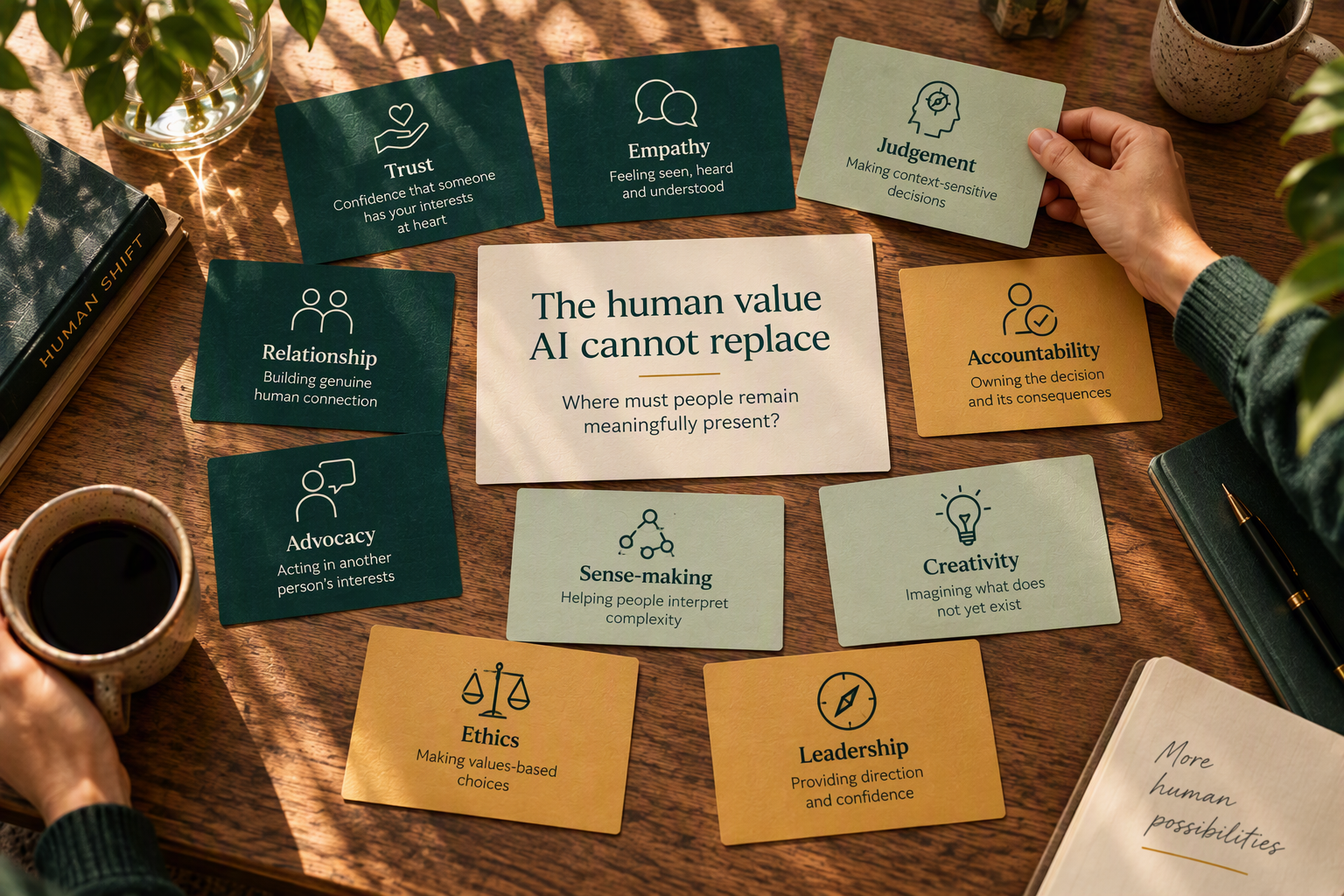
Human Value Mapping helps explore where human contribution matters within a process, product or service. A useful place to begin is with work already being considered for AI, with a particular focus on bringing together the work itself and the experienced outcome.
A number of human-centric lenses offer different ways to look inside that work. Trust, empathy and relationship help explore where someone needs to feel understood, confident or connected. Judgement, sense-making and creativity draw attention to how people interpret a situation, weigh options and imagine possibilities. Accountability, advocacy, ethics and leadership help examine who takes responsibility, whose interests are represented and how choices and direction are shaped.
Each lens brings a different perspective to light. Where does a person’s involvement make a difference? How could AI support that contribution? What might become more difficult to notice, resolve or learn as the work evolves? The same process can also reveal where employees develop capability and how that learning could continue.
It is worth noting that generally most answers will contain assumptions. “Customers want to speak to a person” may hold in some circumstances, and not in others. Understanding which circumstances, and why, gives an organisation a better basis for deciding next steps.
Human-Centric AI is the deliberate use of AI to strengthen what makes us human. Human Value Mapping brings that intention into decisions about how AI is leveraged in our work.
Try Human Value Mapping with AI
AI can help you examine the human value in a process and surface questions you may have missed. Use the following prompt with a process you are considering to get you started...
Human Value Mapping AI Prompt
Choose one piece of work you are considering for AI. You can use this prompt to explore it before discussing the idea with the people involved.
“Help me explore where human contribution creates value in [describe the process, product or service].
Ask one question at a time. Help me examine who benefits from human involvement, what evidence supports that view and how AI could improve the experience. Consider what people learn through the work and how that learning could continue if it changes.
Challenge my assumptions and identify whose perspective is missing. Then help me choose one small change to test, including how any time saved could be used. Leave the final judgement with me.”
A final thought
Understanding where human value sits gives an organisation gives us a clearer basis for deciding what to automate, where people need to remain involved and how AI could help them contribute more effectively. It also helps identify the experience and learning people need to keep making that contribution. Both of which can mature the AI ROI conversation and preserve potential bottom line impacts.
As AI takes on more activity, where could people have more time, support and authority to contribute what matters? How can it be used deliberately to enhance the value a human brings to an organisation?
Written by Jo Grubb
Human Shift Advisory · 2026
A note on AI use in this article: For this article, AI helped with image creation, research discovery, pressure-testing ideas and editing. The thinking, synthesis, interpretation and conclusions remained human. Industry experience and expertise shaped the ideas and determined what to use, challenge, change or leave behind. This reflects the philosophy behind Human-Centric AI, which is the deliberate use of AI to strengthen what makes us human.